Wellbeing Is No Longer an Initiative, It’s a Leadership Strategy
Aug 25, 2026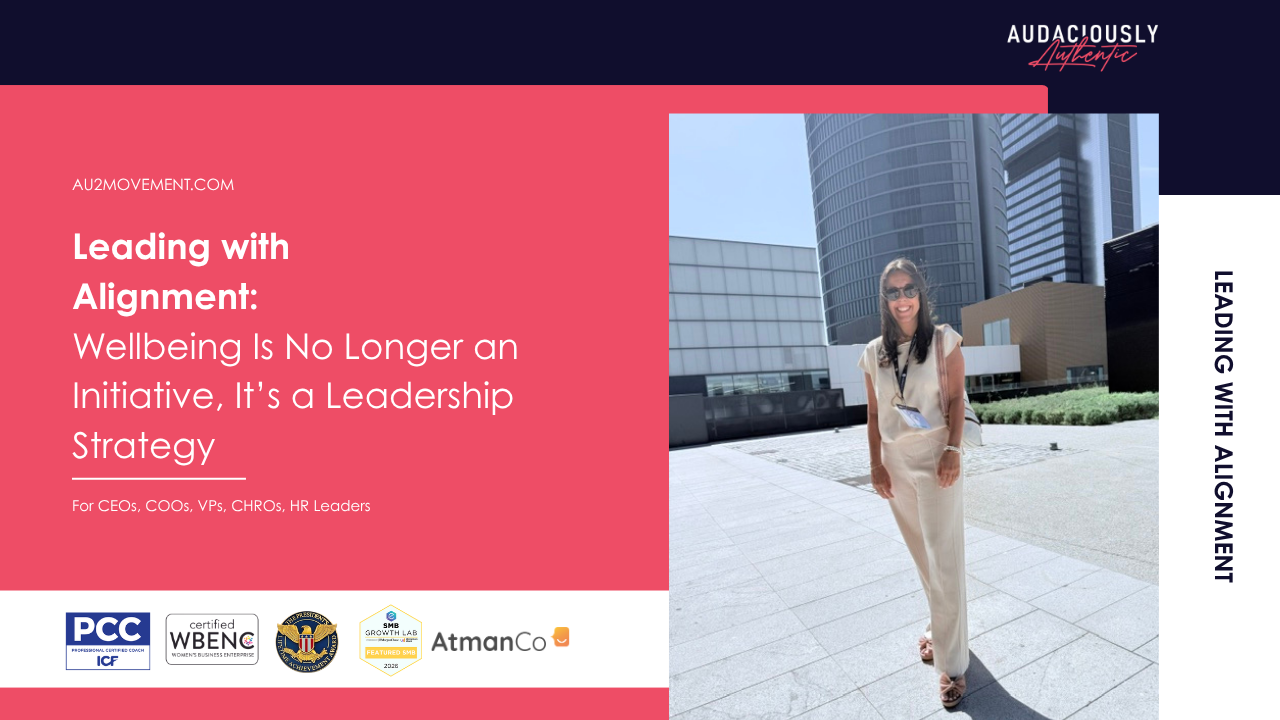
Workplace Wellbeing — Audaciously Authentic
TL;DR: After attending the Wellbeing at Work World Summit at IE University in Madrid, Anadel Alberti, founder of Audaciously Authentic, argues that workplace wellbeing has moved from an HR initiative to a leadership and organizational-design strategy. She explains why managers — not executive speeches or perks — determine whether wellbeing succeeds, and what "embedded" wellbeing actually requires.
Attending the Wellbeing at Work World Summit in Madrid, Spain at IE University was not originally part of my trip plans.
But during a conversation with the CEO of the organization Mark Rix, he casually mentioned the event date and turns out I was going to be in Madrid that same day.
And honestly... I couldn't not go.
Because if there is one conversation organizations can no longer afford to postpone, it is this one: Workplace wellbeing is no longer optional. And it is no longer simply an HR initiative.
It is a business, leadership, sustainability, and cultural imperative.
What became evident throughout the summit was that the organizations making meaningful progress in wellbeing are not treating it as a trend, a campaign, or a set of isolated activities.
They are embedding it into the way leadership, culture, performance, and work itself are designed.
Wellbeing Is Not About "Climate Control"
One statement shared during the summit stayed with me: "Leadership is not about climate control..."
And that distinction matters deeply.
Because many organizations are still trying to manage wellbeing reactively:
- → adding programs,
- → launching initiatives,
- → increasing perks,
- → or measuring participation.
But wellbeing cannot be sustained through isolated interventions alone.
The companies leading this conversation globally are shifting from:
- → programs → to system design,
- → sponsorship → to accountability,
- → initiatives → to culture,
- → perks → to leadership behaviors.
That is a completely different mindset.
The Organizations Doing This Well Have One Thing in Common
Whether hearing insights from leaders at Globant, Heineken, Ferrovial, Sanitas, Amadeus, or other organizations represented in the room, one message consistently emerged:
Wellbeing works when it is embedded. Not when it is performative. Not when it is seasonal. Not when it exists only in presentations or internal campaigns.
Embedded means:
- → managers understand their role,
- → leadership behaviors reinforce it,
- → psychological safety exists,
- → flexibility is intentional,
- → and wellbeing is integrated into decision-making itself.
One organization shared they have close to 200 wellbeing ambassadors helping sustain the work internally.
Another emphasized that managers are "multipliers" of culture.
And that may have been one of the most important insights of the entire summit.
Because workplace wellbeing rarely succeeds or fails at the executive speech level.
It succeeds or fails at the manager level.
Managers Are the Real Drivers of Workplace Experience
Organizations often invest heavily in wellbeing initiatives while overlooking the people who shape employees' daily realities the most:
Managers.
The summit repeatedly reinforced that:
- → manager quality,
- → communication,
- → psychological safety,
- → feedback,
- → workload management,
- → and autonomy
are among the strongest predictors of employee wellbeing and performance.
Research supports this directly.
According to Gallup
managers account for at least 70% of the variance in employee engagement.
And engagement is deeply connected to:
- → productivity,
- → retention,
- → wellbeing,
- → and organizational performance.
Another important theme discussed was psychological safety.
Employees cannot thrive in environments where:
- → feedback feels unsafe,
- → pressure is constant,
- → communication is inconsistent,
- → or leaders only prioritize output without understanding human capacity.
Because eventually, performance without sustainability becomes burnout.
The Future of Wellbeing Is Organizational Design
One of the most powerful shifts discussed throughout the summit was this:
The future of wellbeing is moving away from isolated programs and toward organizational design.
That means asking deeper questions:
- → How are decisions made under pressure?
- → Are workloads sustainable?
- → Do employees have autonomy?
- → Is flexibility tailored or imposed?
- → Is communication aligned?
- → Are managers equipped to lead humans, not just tasks?
Because wellbeing is not just about yoga sessions, wellness apps, or benefits.
It is about how work itself is experienced daily.
"Employees can immediately tell the difference between a company that offers wellbeing initiatives... and a company that genuinely operates with wellbeing in mind."
Hybrid Work Requires Listening, Not Assumptions
The conversation around hybrid work also stood out.
One leader shared the importance of asking employees first before implementing return-to-office expectations.
Not assuming. Not imposing. Listening.
Tailoring approaches to different worksites, teams, and realities instead of creating rigid one-size-fits-all models.
Because flexibility without intentionality creates confusion.
But rigidity without listening destroys trust.
The Most Important Question Leaders Should Be Asking
One of the recurring reflections throughout the summit was this:
Why are we doing what we're doing when it comes to workplace wellbeing?
Is it because it is trending — or because leadership genuinely believes human sustainability matters?
Is it because:
- → it is trending,
- → competitors are doing it,
- → participation numbers look good,
- → or because leadership genuinely believes human sustainability matters?
That question changes everything.
Because organizations that truly believe in wellbeing:
- → measure it,
- → integrate it,
- → resource it,
- → and hold leaders accountable for it.
Not temporarily. Consistently.
Final Reflections From the Panel
Several reflections from the panel I attended stayed with me deeply:
"It's not just about wellbeing. It's about sustainability."
"It's not just initiatives and programs. It's part of company culture."
"Communication is critical, from small talks to deep mentoring."
"Wellbeing is not optional. It's a responsibility."
And perhaps that is the clearest takeaway of all.
Workplace wellbeing is no longer a side conversation.
It is directly connected to:
- → performance,
- → retention,
- → trust,
- → leadership,
- → innovation,
- → and the long-term sustainability of organizations.
The companies that understand this now will not only build healthier workplaces.
They will build stronger, more resilient, and more human organizations for the future.
About
Audaciously Authentic
Audaciously Authentic helps CEOs and leadership teams of growing organizations build aligned, high-performing cultures that scale. Through its DAL framework, the firm equips leaders to strengthen decision-making, activate teams, and implement the systems needed for sustainable growth.
Clients report faster execution, stronger accountability, and improved team performance, along with greater clarity across roles, priorities, and communication. Audaciously Authentic provides the structure and partnership leaders need to turn vision into consistent results. Learn more here: Audaciously Authentic
Learn More →This article was originally published in the Leading with Alignment newsletter on LinkedIn on May 28, 2026
Stay connected with news and updates!
Join our mailing list to receive the latest news and updates from our team.
Don't worry, your information will not be shared.
We hate SPAM. We will never sell your information, for any reason.