Trust as a Performance Driver
Sep 22, 2026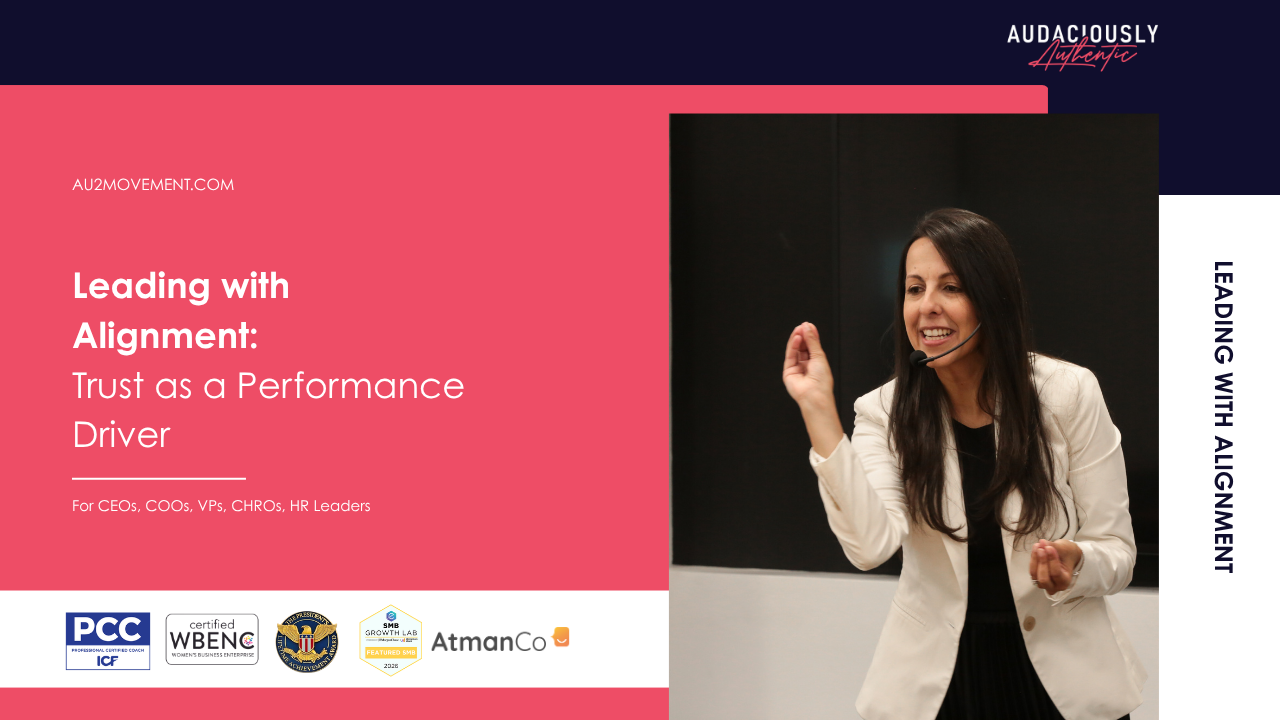
Trust Is a Performance Driver — Audaciously Authentic
TL;DR: Anadel Alberti, founder of Audaciously Authentic, makes the case that trust is not a cultural "nice to have" but a measurable performance driver — one that breaks down from both directions when leaders over-control and employees disengage. This piece explains the real cost of low trust and how aligned leaders rebuild it through clarity, consistency, communication, and shared ownership.
Trust is not a soft, cultural nice-to-have; it is a structural performance driver that shapes communication, initiative, and results.
There's a pattern showing up across organizations, quiet, but deeply disruptive.
Leaders say
"I can't fully trust my team."
Employees say
"I don't feel trusted... and I don't trust leadership."
And in between?
Silence. Disengagement. Work that gets done, but not at its full potential.
What We're Seeing Inside Organizations
Across the companies we've worked with, this tension shows up from both ends:
- → Leaders holding on too tightly, reviewing everything, controlling decisions, hesitating to delegate
- → Employees pulling back, doing the minimum, staying quiet, disengaging emotionally
Not because they don't care. But because trust has been fractured, or never fully built.
When that happens:
- → Communication breaks down
- → Feedback becomes filtered or avoided
- → Initiative decreases
- → Performance plateaus, or declines
And yet, many organizations still try to solve this with more processes, more tools, more oversight.
But trust doesn't improve with more control.
It deteriorates because of it.
This Isn't Soft, It's Structural
Trust is often treated as a cultural "nice to have." It's not — it's a performance driver.
Research consistently reinforces this:
Harvard Business Review
High-trust organizations report 50% higher productivity and 76% more engagement compared to low-trust environments.
LUP
Gallup
Employees who trust their leaders are significantly more likely to be engaged — and teams with high engagement see higher profitability and lower turnover.
PwC
55% of CEOs say a lack of trust is a threat to their organization's growth.
This is not about feelings.
This is about results.
When Employees Don't Trust Leaders
When trust is low in this direction, the impact is immediate:
- → People hold back ideas
- → They avoid risk
- → They disengage from outcomes
- → They do what's required — nothing more
Because from their perspective:
"Why go above and beyond if it's not seen, valued, or safe?"
This is where morale drops, and performance follows.
When Leaders Don't Trust Their Teams
This is the side that often goes unexamined.
When leaders don't trust their teams, it tends to show up as:
- → Micromanagement
- → Over-involvement in decisions
- → Difficulty delegating
- → A need for constant visibility and control
Sometimes it's driven by pressure. Sometimes by perfectionism. Sometimes by lack of leadership development.
But the result is the same:
The team never fully steps into ownership, because it's never truly given.
And ironically, the more control a leader exerts... the less capable and accountable the team becomes.
The Real Cost of Low Trust
When trust breaks down, on either side, organizations pay for it in ways that don't always show up immediately on a report:
- → Slower decision-making
- → Reduced innovation
- → Increased burnout
- → Higher turnover
- → Missed opportunities
And perhaps most critically:
A culture where people stop saying what needs to be said.
Because silence is the natural byproduct of low trust.
The Shift: From Control to Clarity
Trust doesn't mean lowering standards. It doesn't mean blind optimism.
It means creating the conditions where performance can actually thrive.
Aligned leaders build trust through:
Expectations are explicit, not assumed
Actions match words over time
Feedback is direct, timely, and real
Responsibility is shared, not centralized
Because trust isn't built in big moments.
It's built in the daily leadership behaviors that either reinforce or erode it.
A Direct Reflection for Leaders
If trust is low on your team, ask yourself:
- → Where might I be over-controlling instead of enabling?
- → What have I not clearly communicated?
- → Where has inconsistency created doubt?
- → Have I created an environment where people feel safe to speak... or safe to stay silent?
Because trust is not just something your team owes you.
It's something your leadership creates, or constrains.
A Final Thought
Trust doesn't show up on a dashboard. But its impact shows up everywhere.
In the conversations that don't happen. In the ideas that never surface. In the performance that never fully materializes.
So the question isn't whether trust matters.
Is your leadership building it, or quietly breaking it?
If this resonates, start small this week:
- →Have one conversation with more clarity.
- →Offer one piece of honest feedback.
- →Delegate one decision fully.
That's how trust begins to rebuild, and how performance follows.
About
Audaciously Authentic
Audaciously Authentic helps CEOs and leadership teams of growing organizations build aligned, high-performing cultures that scale. Through its DAL framework, the firm equips leaders to strengthen decision-making, activate teams, and implement the systems needed for sustainable growth.
Clients report faster execution, stronger accountability, and improved team performance, along with greater clarity across roles, priorities, and communication. Audaciously Authentic provides the structure and partnership leaders need to turn vision into consistent results.
Learn More →This article was originally published in the Leading with Alignment newsletter on LinkedIn on June 11, 2026
Stay connected with news and updates!
Join our mailing list to receive the latest news and updates from our team.
Don't worry, your information will not be shared.
We hate SPAM. We will never sell your information, for any reason.