From Symptoms to Systems
Sep 08, 2026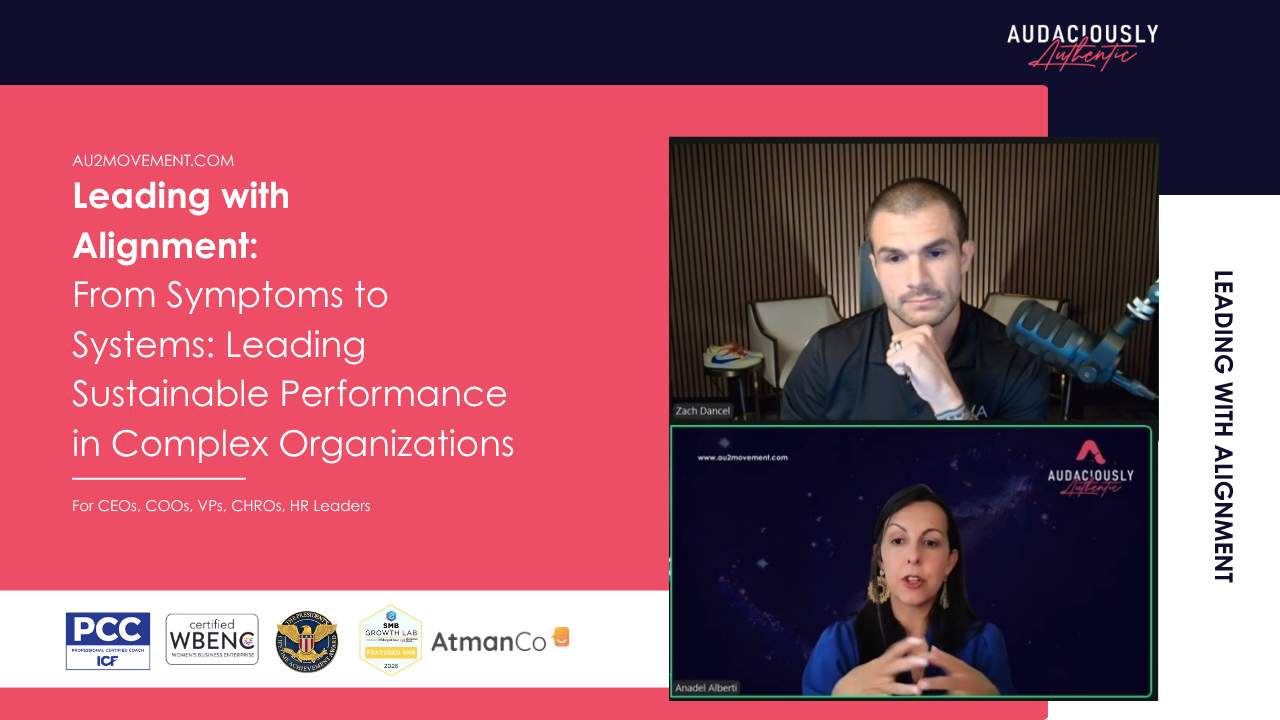
TL;DR: At an Audaciously Authentic Executive Forum with Zach Dancel, COO of Nava Health, Anadel Alberti drew a parallel between organizational health and human health: most leaders treat symptoms — burnout, turnover, missed deadlines — while missing the system that produced them. This piece explains how to shift from reactive firefighting to designing for sustainable performance.
Most leaders are solving the wrong problem.
Not because they lack intelligence. Not because they lack commitment.
But because they are reacting to symptoms while missing the system that created them.
At our recent Executive Forum, From Symptoms to Systems: Leading Sustainable Performance in Complex Organizations, we explored a question that has become increasingly relevant in today's workplace:
How do leaders build organizations that perform well without exhausting their people?
The conversation with Zach Dancel, COO of Nava Health, revealed a powerful parallel between organizational health and human health.
And the lesson was impossible to ignore.
The Problem Isn't What You See
When people visit a doctor, they often describe symptoms:
- → fatigue
- → headaches
- → weight gain
- → inflammation
- → anxiety
The symptom isn't the problem...It's the signal.
As Zach shared through his family's experience navigating traditional and functional medicine, true healing began only when someone took the time to understand the root cause rather than simply treating what appeared on the surface.
Organizations are no different.
Leaders often focus on symptoms such as:
- → burnout
- → disengagement
- → turnover
- → missed deadlines
- → communication breakdowns
- → declining performance
Yet these are rarely the actual problems. They are indicators that something deeper within the system requires attention.
The Cost of Reactive Leadership
Many organizations operate in a constant cycle of reaction. A key employee leaves. A project falls behind. A customer complains. Engagement scores decline.
The response is often immediate: Fix the issue. Replace the person. Add another process. Schedule another meeting.
But reactive leadership creates a dangerous pattern. Instead of solving root causes, leaders become professional firefighters. And firefighters rarely have time to redesign the building.
Research supports this challenge.
According to Gallup
Only 23% of employees globally are engaged at work, while manager effectiveness remains one of the strongest drivers of team performance and wellbeing.
According to Gallup
Managers account for up to 70% of the variance in employee engagement.
The implication is significant: The issue is often not the individual employee...It's the environment surrounding them.
Sustainable Performance Leaves Clues
One of the most powerful concepts discussed during the forum was the difference between high performance and sustainable performance.
Many organizations celebrate output. Few measure sustainability.
A team can hit targets while simultaneously:
- → experiencing burnout
- → losing creativity
- → avoiding difficult conversations
- → delaying decisions
- → operating in survival mode
From the outside, performance appears healthy. Underneath, the system is weakening.
As Zach described, organizations need their own "biomarkers."
Just as functional medicine uses data to understand health, leaders must identify indicators that reveal the true health of their teams.
Questions leaders should be asking include:
- → Are our best people consistently exhausted?
- → Are employees using their PTO?
- → Has creativity declined?
- → Are teams proactive or reactive?
- → Are response times slowing down?
- → Are managers spending more time putting out fires than building capability?
These indicators often reveal system stress long before performance metrics do.

Culture Is Not a Poster
One insight that resonated deeply was the role culture plays in scalability.
Many organizations claim culture is important. Yet culture often exists only as words on a wall....Mission. Vision. Values.
Visible.
But not lived.
The organizations that successfully scale understand that culture is not a communication exercise.
Culture is an operating system.
Culture determines:
- → how decisions are made
- → how people communicate
- → how accountability is handled
- → how leaders behave under pressure
- → how employees experience work every day
As organizations grow, culture becomes even more important because leaders can no longer personally influence every employee.
The culture must do the work when leaders are not in the room.
Data Matters. But Listening Matters More.
Another important theme emerged throughout the discussion:
Leaders need diagnostics before prescriptions.
Too often organizations attempt solutions before understanding the problem. They launch initiatives before gathering insights. They implement programs before listening. They create strategies before asking employees what is actually happening.
Metrics matter.
KPIs matter.
Performance data matters.
But sustainable organizations pair data with something equally important: Listening.
The people closest to the work often see problems long before executives do.
The question is whether leaders have created an environment where employees feel safe enough to share what they see.
Moving From Symptoms to Systems
If leaders want to build healthier organizations, the shift starts with a different set of questions.
Instead of asking:
"How do we fix this problem?"
Ask:
"What system created this outcome?"
Instead of asking:
"Who is responsible?"
Ask:
"What conditions made this possible?"
Instead of asking:
"How do we improve performance?"
Ask:
"What is preventing performance from being sustainable?"
Those questions move leaders beyond reaction.
They move them toward design.
On a Final Note...
One of the most powerful lessons from functional medicine is that symptoms are not inconveniences.
They are information.
Organizations work the same way.
- → Burnout is information.
- → Turnover is information.
- → Disengagement is information.
- → Communication breakdowns are information.
The leaders who create sustainable organizations are not the ones who ignore those signals. They are the ones who become curious enough to investigate them.
Because the future of leadership is not about becoming better at managing symptoms.
It's about becoming skilled at understanding systems.
And when leaders learn to see the system, sustainable performance becomes possible.
Exploring Organizational Alignment?
Through executive coaching, leadership development, organizational diagnostics, and culture transformation work, we help leaders uncover the systemic patterns influencing performance, engagement, and growth.
If you're navigating recurring organizational challenges and would like an outside perspective, we'd welcome a conversation.
About
Audaciously Authentic
Audaciously Authentic helps CEOs and leadership teams of growing organizations build aligned, high-performing cultures that scale. Through its DAL framework, the firm equips leaders to strengthen decision-making, activate teams, and implement the systems needed for sustainable growth.
Clients report faster execution, stronger accountability, and improved team performance, along with greater clarity across roles, priorities, and communication. Audaciously Authentic provides the structure and partnership leaders need to turn vision into consistent results.
Learn More →This article was originally published in the Leading with Alignment newsletter on LinkedIn on Jun 4, 2026
Stay connected with news and updates!
Join our mailing list to receive the latest news and updates from our team.
Don't worry, your information will not be shared.
We hate SPAM. We will never sell your information, for any reason.